My grandmother, a woman whose mere presence filled a room with warmth, possessed what she charmingly referred to as a “sweet toot.” With her gentle, melodic French accent, a whisper of her Acadian heritage, she would always ensure life had a touch of sweetness. Born Dion, her father had anglicized their surname to “DiYoung” during an era when being Acadian often carried an unfair stigma. She was one of eighteen children, raised in a bustling French-Catholic family, and truly, she was the epitome of a wonderful grandmother – a matriarch whose love was as abundant as her family.
I can still recall, with vivid clarity, the simple yet profound act of her firmly packing my ice cream into the bottom of a cone with a tiny spoon. It mattered not that the ice cream sometimes suffered from freezer burn, that its unique Grape Nuts flavor was a distinctive choice, or that the cone itself was a bit stale. To my young, knotty-haired elementary-school self, every lick was an unmistakable taste of pure, unadulterated love. Those were the moments that shaped my childhood, etched in memory as symbols of her unwavering affection.
In her graceful later years, my grandmother’s hearing had diminished considerably, and confusion would occasionally cloud her sharp mind. It was during this period that my grandfather harbored a pet cockatiel named Chicklet, a feathered rogue notorious for his Houdini-like escapes from the confines of his cage. One afternoon, as grandma was indulging her beloved “sweet toot” in the quiet sanctuary of the kitchen, Chicklet, seizing his moment, made another daring bid for freedom.
The living room instantly transformed into a scene of utter pandemonium. My mother, my sister, and I were a blur of motion – shrieking, diving, and flailing towels in desperate attempts to trap the elusive bird whenever he dared to land. Meanwhile, blissfully unaware of the avian acrobatics and our frantic pursuit, Grandma continued to enjoy her afternoon tea in perfect serenity, savoring her sweet treat in the next room, a picture of calm amidst our chaos.
After what felt like an eternity – easily ten minutes of entirely unsuccessful towel-trapping – Chicklet had escalated his pursuit of freedom into a frenzied, triumphant ballet. He tore through the living room airspace, squawking hysterically with gleeful abandon. The furniture, a silent witness to his liberation, soon bore unsightly splotches of bird droppings, while we, his weary, exasperated, and sweaty would-be captors, were on the brink of giving up. A particularly loud shriek from us, or perhaps the crash of a dropped towel, must have finally pierced through her quiet enjoyment, beckoning grandma from her cake. She eventually emerged from the kitchen, a fork still clutched firmly in her hand, curiosity piqued by the sudden silence.
By this point, the towels had been unceremoniously abandoned, scattered across the floor like fallen flags. As the cockatiel happily swooped and dived over our heads, revelling in his evasion of capture, we had resorted to a new strategy: standing perfectly still, our hands outstretched into the air, breathlessly pleading with him in syrupy-sweet voices to come perch on our open palms, hoping to lure him back to safety.
“What’s going on?” grandma implored, her voice a gentle query amidst the lingering echoes of chaos. She was aware of the commotion’s aftermath but still seemed remarkably oblivious to the squawking bird and the tell-tale feathers still drifting through the air.
“CATCH THE BIRD!” my mom suddenly shouted, her voice sharp with urgency, as Chicklet, with a triumphant flutter, soared directly over our heads and made a beeline for the kitchen doorway where grandma stood, looking utterly bewildered by the spectacle.
As Chicklet flapped his wings and zoomed over each of us, our hands instinctively sprang up, fueled by a last glimmer of hope for capture. At this critical juncture, grandma seemed to half-catch the drift of the situation. So, when poor Chicklet zipped directly over her head, she, with a surprising burst of instinct, mimicked our desperate actions, her arm shooting up into the air in a swift, unexpected motion.
I can still see it in slow motion, a memory frozen in time: her wrinkled, thin arm shooting straight up with astonishing timeliness and precision…
…FORK CLUTCHED TIGHTLY IN HER GRIP, its tines glinting menacingly.
A unified, gut-wrenching cry erupted from us all. We slapped our faces in unison, shrieking, “NOOOOOOO!!!!!!” as the scene unfolded before our horrified eyes.
Frozen in that unified scream, we watched, as if time itself had slowed to a crawl…
…as Grandma came thisclose – an agonizingly narrow margin – to the mid-flight skewering of our beloved, albeit mischievous, Chicklet. It was a heart-stopping moment that perfectly captured the unpredictable humor of family life.
The bird, acutely aware of his incredibly near-forking experience, reacted with astonishing speed, making a hasty retreat straight to the perceived safety of his cage. He continued to emit indignant squawks, however, clearly protesting the violent loss of a single, crucial tail-feather during his harrowing escape from the accidental culinary fate. The silence that followed was quickly filled with our collective relief.
With the crisis averted, the tension broke, and relief washed over us, dissolving into uncontrollable giggles. We collapsed onto the floor, tears streaming down our faces, not from fear, but from the sheer, overwhelming absurdity and hilarity of what had just transpired. It was a family moment we would recount with laughter for years to come, a vivid illustration of the unexpected joys and chaos of life with Grandma.
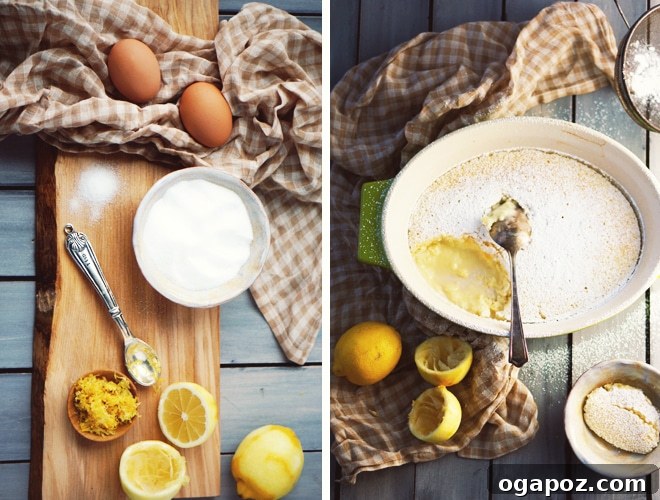
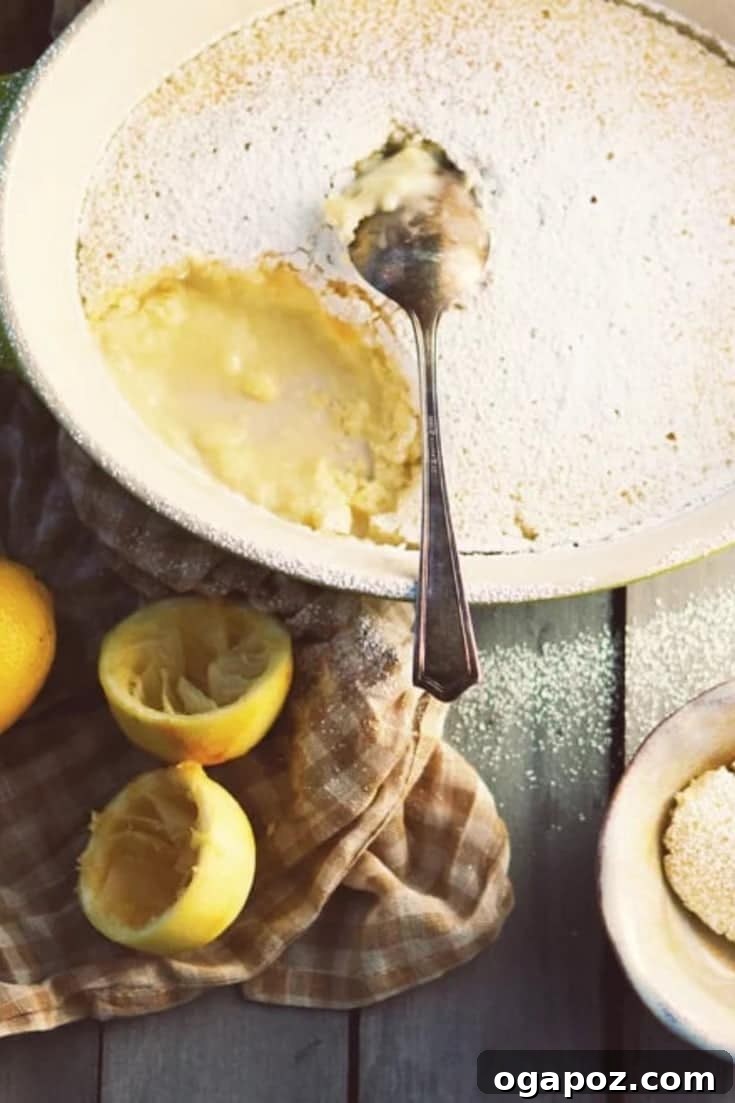
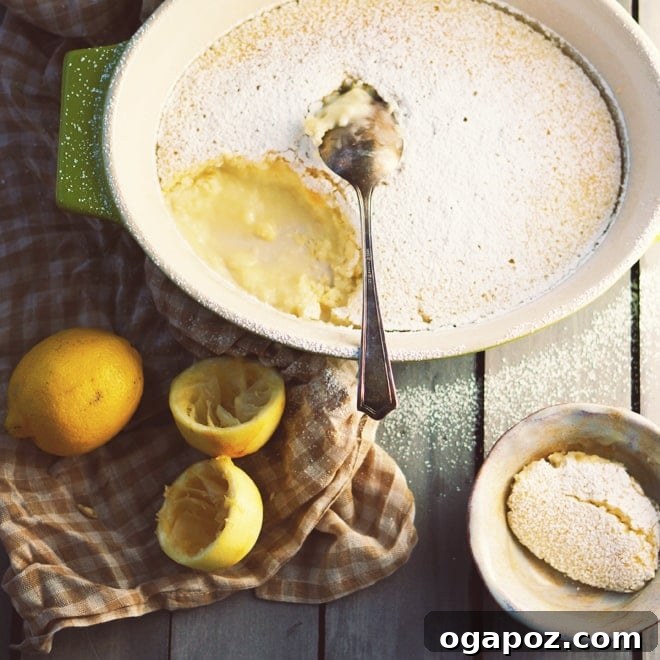
Today, with a heart full of both tears of laughter and profound love, I am honored to share with you a cherished legacy: my dear grandmother’s recipe for what she simply called “lemon sponge.” This isn’t just any dessert; it’s a testament to her spirit, her joy, and the enduring sweetness she brought into our lives. This exquisite treat embodies the simple elegance and comforting flavors that defined her home, making it a perfect easy lemon dessert for any occasion.
I honestly believe this “puckersome,” saucy lemon creation is my all-time favorite dessert. I admit, my food-loves can be delightfully fickle (especially these days, with so many culinary adventures to explore). But at this very moment, I am unequivocally enamored with Grandma’s Lemon Pudding Cake. Its nostalgic charm and delightful taste are unparalleled. (Though, I must confess, this Easy Lemon Tart baked in my great Aunt’s vintage pan runs a close second in the realm of irresistible lemon treats.) This homemade lemon dessert truly stands out.
What makes this Lemon Pudding Cake so extraordinary is its deceptive simplicity and incredible texture. With only three tablespoons of flour and a single tablespoon of butter, it achieves an astonishing lightness, yet remains seductively luscious. The magic begins when delicate egg whites are beaten into soft, ethereal peaks and then gently folded into a rich, yolk-y lemon base. The dessert is then lovingly baked in a water bath – a crucial step that ensures its moist, tender perfection. When it emerges from the oven, a pillowy, airy sponge-cake topping miraculously sits atop a distinct layer of creamy, tart pudding, creating a two-in-one dessert experience that is utterly divine. It’s a classic lemon recipe that consistently impresses.
I recently revisited this beloved recipe, making it for a friend’s dinner party last night – the first time in years. The response was immediate and overwhelming: five people devoured the entire dish with five spoons, foregoing bowls entirely, a testament to its irresistible appeal. The sheer willpower required to keep myself from making it again today, solely for my own indulgence, is a wild exercise in self-control. This easy lemon cake truly is that good, making it a perfect addition to any collection of family dessert recipes.
The only change I’ve subtly introduced to my grandmother’s original version is a slight decrease in granulated sugar and a complementary boost in fresh lemon juice and zest. My own “sweet toot” isn’t quite as pronounced as hers was, and I find this small adjustment perfectly balances the tartness and sweetness, enhancing the bright citrus notes without overwhelming them. It’s a minor tweak to a perfect vintage lemon cake, ensuring its timeless appeal for modern palates.
P.S. I don’t think Chicklet ever dared to fly the coop again after his near-spearing incident. And, to be honest, I doubt he ever fully forgave poor grandma for the accidental trauma.
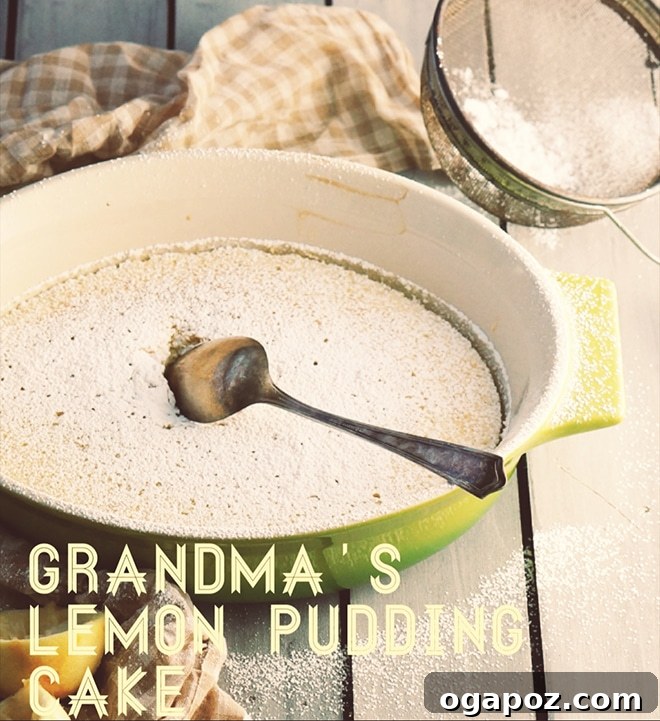
Grandma’s Lemon Pudding Cake: Ingredients
To recreate this beloved homemade lemon dessert, gather these simple yet essential ingredients. Each component plays a vital role in achieving the signature light sponge and creamy pudding layers of this delightful Lemon Pudding Cake.
- 1 tbsp unsalted butter, softened to room temperature
- 3/4 cup granulated sugar (adjust to 2/3 cup for a less sweet, tarter flavor profile)
- 3 tbsp all-purpose flour, sifted for lightness
- 1/4 tsp baking powder, for a perfect rise
- 1/8 tsp salt, to balance the flavors
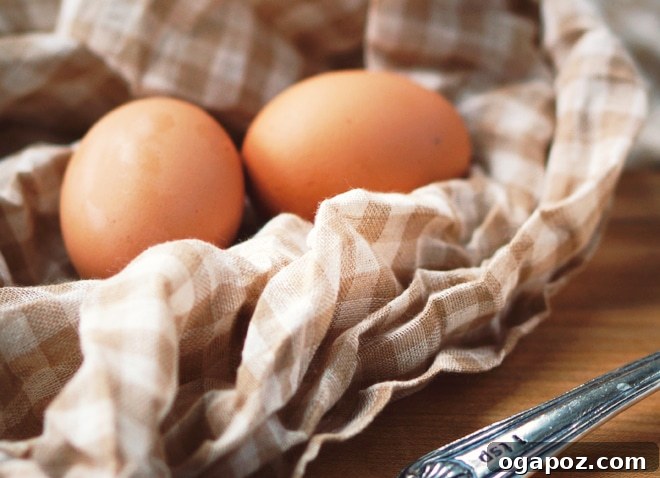
- 2 large eggs, separated carefully (yolks for richness, whites for structure)
- 2 fresh lemons, zested and juiced (aim for about 1 tbsp fine zest and 1/4-1/3 cup fresh juice for optimal lemon flavor)
- 1 cup whole milk, for creaminess
- Icing sugar (confectioners’ sugar) for dusting, optional but highly recommended for a beautiful finish
Preparation: Baking Grandma’s Lemon Pudding Cake
Follow these detailed steps to ensure your homemade Lemon Pudding Cake turns out perfectly – a truly easy lemon cake with impressive results. The water bath method is key to its unique texture.
- Preheat Oven & Prepare Water Bath: Begin by preheating your oven to 325 degrees F (160 degrees C). Simultaneously, set a kettle full of water to boil. This hot water will be essential for the water bath, which ensures a moist and delicate bake for your lemon sponge.
- Cream Butter & Sugar: In the bowl of a standing mixer fitted with the paddle attachment, or using a hand mixer, beat the softened butter with the granulated sugar until the mixture is light, fluffy, and fully incorporated. This creates a foundational sweetness and tender crumb.
- Add Dry & Wet Ingredients: To the creamed mixture, add the sifted all-purpose flour, baking powder, and salt. Mix on low speed until just combined. Next, beat in the egg yolks one at a time, ensuring each is fully incorporated before adding the next. Follow with the fresh lemon zest, vibrant lemon juice, and finally, the milk. Mix until the batter is smooth and well-combined, scraping down the sides of the bowl as needed.
- Whip Egg Whites: In a separate, impeccably clean bowl (any trace of grease can prevent whites from whipping), beat the egg whites with clean beaters until soft peaks form. This means the whites will hold their shape but the tips will gently curl over. Do not overbeat to stiff peaks, as this can make folding difficult.
- Gently Fold Whites into Batter: Using a spatula, very gently fold the beaten egg whites into the lemon mixture. The goal is to incorporate them without deflating the air you’ve just whipped in. It’s normal for the mixture to still have a slightly curdled or separated look at this stage; don’t worry, this contributes to the distinct layers of sponge and pudding.
- Prepare for Baking: Carefully scrape the batter into a 1 1/2 quart (1.5 L) baking dish. An 8×8 inch (20×20 cm) glass dish works wonderfully for this recipe.
- Create the Water Bath: To create the crucial water bath, set your pudding dish into a larger baking pan (e.g., a roasting pan). Carefully pour the hot water from your kettle into the larger pan, ensuring the water comes about halfway up the sides of the pudding dish. This gentle, moist baking environment is what creates the magical separation into a light sponge top and creamy pudding bottom.
- Bake to Perfection: Carefully transfer the entire water bath setup to your preheated oven. Bake for approximately 55 minutes, or until the top of the cake is set and springs back lightly when touched. The edges may be lightly golden.
- Cool & Serve: Once baked, carefully remove the dish from the water bath (using oven mitts to protect your hands) and place it on a wire rack to cool. This Lemon Pudding Cake can be served warm, straight from the oven, or chilled. If desired, dust generously with icing sugar just before serving for an elegant touch.
This light, luscious, and utterly unique Lemon Pudding Cake is more than just a dessert; it’s a taste of family history and a recipe that will bring smiles and stories to your table for years to come. Enjoy this delightful classic lemon recipe, passed down with love!